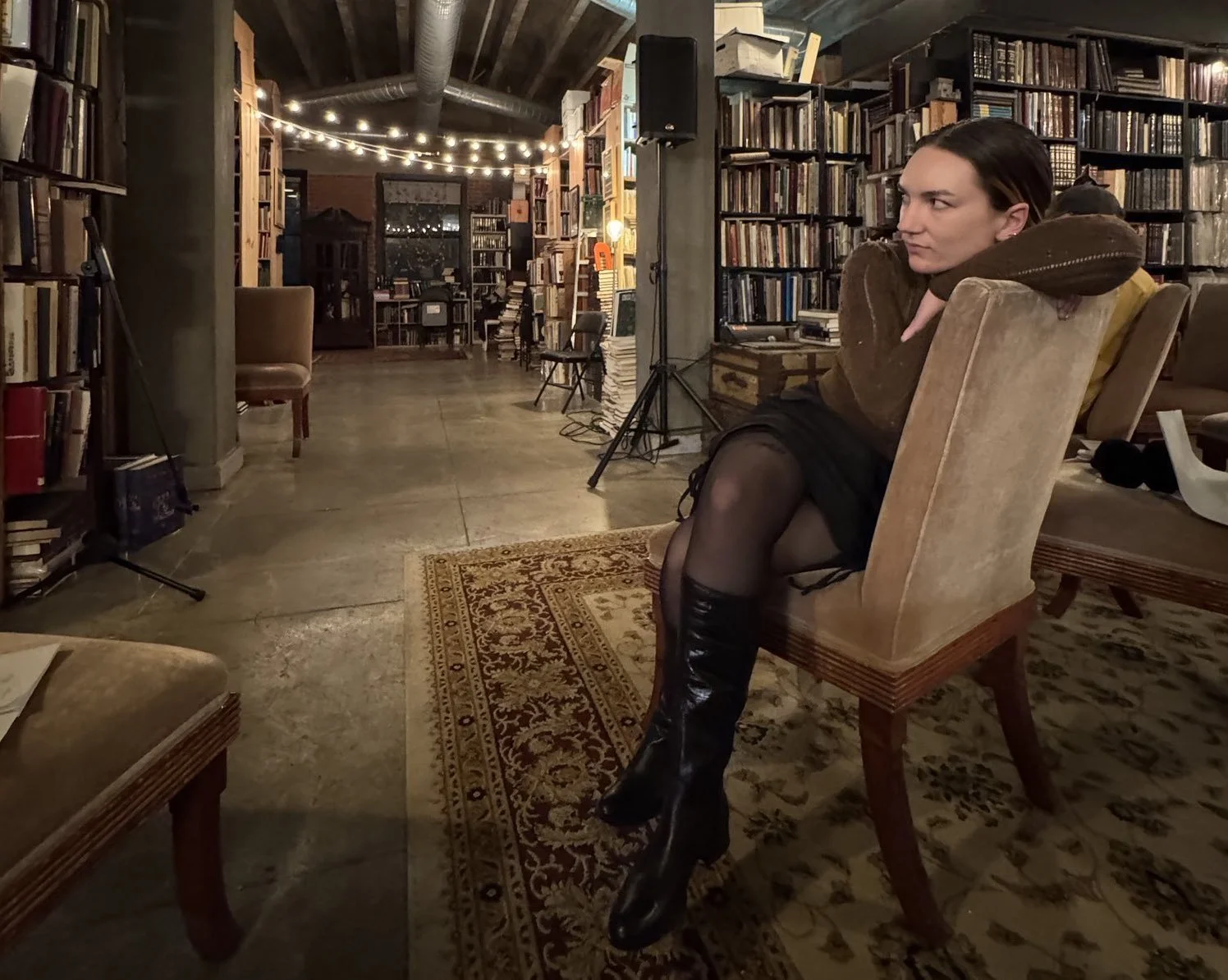
Dreams in Romania
In the weeks and months before my recent trip to Romania—I just returned a few days ago—I had a recurring dream where I was on a train that stopped mid-way. Trains have complicated associations for me, as they do for many Jews. For me, the train’s symbolic meaning really congealed when I was commuting from Union Station to Irvine a few days a week, and reading Elie Wiesel’s Yiddish language Auschwitz testimony, And the World Was Silent/ Un Di Velt Hot Geshvigen, on the journey. Thinking about the terrible train journey that took the Jews of Sighet away, and realizing at some point that my train to Irvine passed by the Men’s County Jail in downtown LA every day, I began to feel an awareness of a global network of suffering: the Holocaust never ended completely, suffering is everywhere, and trains are taking people to places of internment.
Because of Wiesel’s testimony, I do think of the train as something that took Jews away from where we came from, toward certain death or toward refuge when they were fleeing persecution, or to urban centers when they sought a bigger, freer life than the shtetl could provide. In the dreams I was having, the train was always heading back to Romania, back to where Wiesel’s train came from, back to where I feel I came from in some broader, historical sense–at least a part of my family, and therefore a part of my story, begins there, and the train was taking me on a journey of return. In this dream, the train would always stop, and we wouldn’t be allowed to get off of it, and inevitably this brought a mild, low level of panic. My return was thwarted, and forever incomplete.
In Romania I had a series of nightmares. Some I won’t bore you with here. After about a week had passed, it was the night before our trip to Satu Mare. This is the home of Satmar Hasidism, one of the largest orthodox communities in Williamsburg. On this, the night before our journey, I had another nightmare. Here, I was standing on a hilltop with the entire group of Yiddishists that I was gathered with in Romania. A fire broke out, suddenly and massively, as they are wont to do, with the feeling of an explosion. “Not again,” I thought. (My unconscious was very marked by last January’s fires in LA.) I immediately began to run, carrying a ladder at first, but then I realized I was running faster than everyone else and the ladder should stay with the group where it could be used. I set down the ladder and kept running. I got away from the fire, but then I was alone, and had to look for the others.
The day after that nightmare, I got on the bus to Satu Mare. I was late so it quite nearly left without me, but we did make it there in the end, without unexpected stops or detainment. Not even a checkpoint. We entered the shul, where Satmar Hasidim visiting from London were davening at the exact time we walked in. They spoke to us, and we spoke to them, and a few men in our group danced with them in a circle. During the davening, I closed my eyes and saw fire. This was a very spiritual experience.
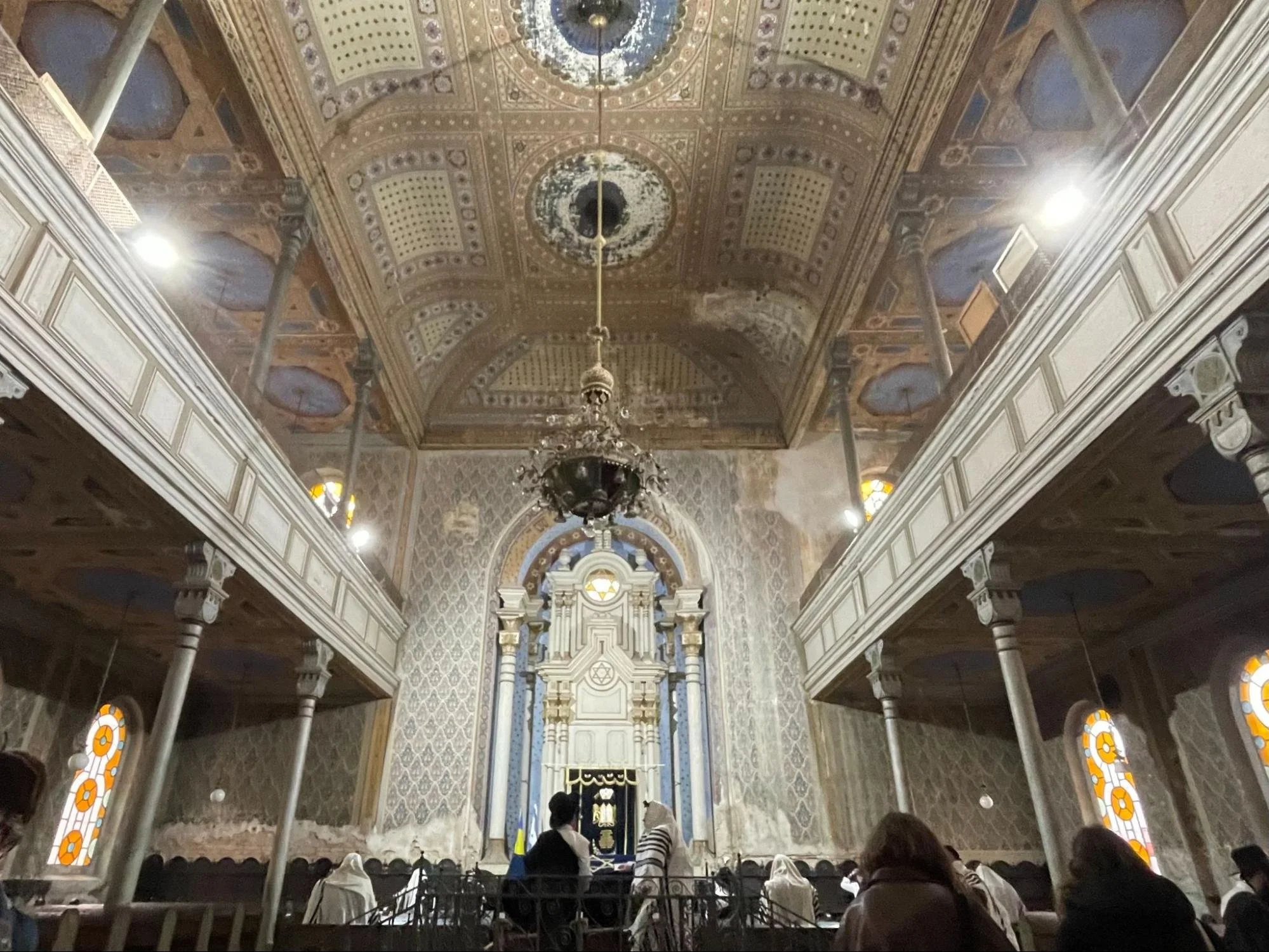
The Hasidic shul in Satu Mare.
All the dreams I had of a thwarted journey were disproven. We really did go there, to the place I associate with the past, and we touched it. We prayed there, the same words that Jews of a bygone time prayed in that very same shul. My dream of fire is one I still have to interpret. The people I reported it to on the trip said there’s something about survivor’s guilt, and I agree. I think there’s also a meaning about being part of a community, when going alone is easier, when it might involve less risk.
Here is something I wrote on the return journey home, which took 24 hours exactly, mostly spent reading and writing in a state of delirious exhaustion: “The past is still there, in the place where it once happened, but is only as present as a blank page can be. We must choose the meaning of the absence that we see; the ones no longer there cannot speak for themselves. Armed with limited evidence and a not-yet-fluent working knowledge of the language they once spoke, I begged the ancestors to appear to me, or for anything to let me know I was in the right place.”
On the 24-hour journey home from Romania, refrains from two poems were ringing in my mind. The two poems are "Corona" by Paul Celan and "Once I Was Young" by Anna Margolin.
Both of these poems speak to the necessity of redefining history in order to be in relation to the past. Margolin's "Once I Was Young" is a Yiddish poem that begins by saying "Once I was young, hung out / in doorways, listening to Socrates," thus putting modern Jewish language in the mouth of an ancient Greek goy. The poem concludes by referencing the Jews from the Greek perspective: "I'd hear / about the Nazareth weakling / and the exploits of the Jews." The idea, or the conceit of the poem, is that the narrator gets to decide who they were even if it doesn't make sense: in the past, a Greek speaks Yiddish. When we look back at history, and try to imagine who we would have been and what we would have done back then, there is a requirement of insufficiency and guesswork, illogic or the absence of sense.
In "Corona," one line in particularly was ringing in my ears in Münich airport: "die Zeit kehrt zurück in die Schale." Time turns back into its shell. Time, like everything else, has what the kabbalists call the "kelippot", the outer husk that masks shards of divinity within each and every thing. Time crawls back into its shell, retracts from its constant passing by us and undoing of what once was; in the moment of time's retreat, we can touch the thing that used to be there. This is how I felt touching the shul in Romania, and the graves, and speaking Yiddish there: undoing time, making it turn back on itself. This poem is also about love, which I felt for everyone else who was there. We were all a part of something, and the retreat of time would not be possible without the companionship and love we shared between us.
My feeling, overall, while back in Romania was that I really had found the thing I was looking for. The past was even more accessible than I had dreamed it would be. Speaking Yiddish there, with others, seemed to unlock it for me. Next week I plan to write about my realizations involving Catholicism–yet another secret revealed, at least, partially, in a dream.